

The spectacular business of buying new glasses
You wanted Clark Kent. You got Edna Mode.

Nothing will humble you so quickly as shopping for a pair of glasses.
You go in with lofty ambitions: spectacles that reveal your hidden depths and your good side. In a perfect world, your new frames will suggest that, if removed, you might dazzle the viewer with all your devastating glory (“But Miss Jones! You’re gorgeous!”), or reveal a striking resemblance to a young Michael Caine, as you always secretly suspected.
Then you look in a mirror, and the truth hits you square in the face, as arresting and sick-making as November backsplash from a London bus. You thought you were Stanley Tucci. You’re Roz from Monsters Inc. So it goes.

At Bloobloom, a “disruptive” eyewear company in whose well-lit branches I have lately lingered far too long, the gap between aspiration and reality is particularly stark. Every set of frames is named for the role the wearer hopes to assume: the Altruist; the Author; the Diplomat; the Prophet. There’s nothing like putting a name to a thing to remind you of what you are not.

I never expected to find myself in this situation — or, at least, not quite so soon. A few years ago, calculating that it would, after about a decade, represent a saving on daily contact lens costs, I got laser eye surgery.
I booked a consultation session at a clinic in a ritzy part of Melbourne, with an appropriately assured South African surgeon. The procedure itself was quick and deeply strange — lying very still and focusing on a small light. I had the slight fear that if I looked in the wrong place I’d suddenly be blinded. Days later, I binned my contact lenses and glasses for good.
For the first time since childhood, I could see the moon from my bed and swim without wondering if a water-dwelling parasite was going to lodge under my contact lens. It also put to bed my unvoiced anxiety that in an apocalyptic situation involving a plane crash, I would be unable to see and eventually perish in the jungle. It felt miraculous.
Lately, though, street lights have looked smeary, and at concerts, I couldn’t quite focus on the musicians’ faces. The eventual diagnosis was very mild astigmatism — a normal eyeball is basically round; mine are more like eggs.
If it bothered me, I should get glasses for occasional wear, and perhaps try not to spend roughly 60 hours a week in front of a computer screen.
I was born with wonky eyes — a so-called “alternating squint” that defied surgical intervention and left me with a lifelong antipathy to ball sports. As a child, I found my poor hand-eye coordination distressing and dreaded any occasion when somebody might throw something at me. An unanticipated perk of adulthood is that netball is optional.
To this day, I can only focus with one eye at a time, while the other hangs around on standby. When I’m tired, it drifts lazily away — one goes out; the other up — giving me the glassy-eyed affect of a haunted doll.
The myopia asserted itself later. By 13, I wore glasses or contact lenses every day. Eventually, my prescription settled at just over -7 — bad enough that, unaided, I could only see within about 14 centimeters, or sixish inches, from my face.
On one trip to Normandy, aged about 18, I forgot to pack either glasses or contact lenses and was functionally unable to see pretty much anything all weekend. At the time, I was going through a photography phase, and the only way I could “see” the scenery around me was by shooting it on my D-SLR and scrutinising the image on the two-inch screen. What memories remain have logged as intense close-ups (Calvados; rain) or through a gloppy conjunctival blur.
Because I was so short-sighted, the lenses of my glasses were almost as thick as wheels of Babybel cheese, substantially limiting my choice of frames. They already looked silly, but because I tended to leave them in stupid places where they would then be trodden or sat on, they also sat permanently askew. Mostly, I wore contacts.
On other people, I hasten to add, I rather like glasses, finding them somewhere between appealing and actively alluring. Not for nothing is Daniel Vettori (swoon!) one of only three male cricketers I can name.1 On myself — well, I’d look in the mirror and see Piggy, from Lord of the Flies.

For most of human history, I, along with many of the almost two-thirds of adults who require some vision correction, would have been essentially useless. Spectacles in general are less than 1,000 years old, and glasses for myopia didn’t come along until sometime in the 15th century.
Most early eyeglasses were held in one hand or clipped onto the nose, and it took our brightest luminaries a few hundred years later to figure out that you could use ears to keep them in place. At first, like most early wearable tech, they were rudimentary and expensive — the exclusive preserve of cardinals and kings. (Henry VIII was a spectacles-wearer, perhaps inspiring this comedy helmet from Holy Roman Emperor Maximilian I. A white elephant gift for the ages.)
These days, of course, there’s a frame for every occasion and every possible persona. Young people online talk about what they call “hair theory” — the radical notion that you look different with different hairstyles. “Glasses theory” doesn’t exist, to my knowledge, but perhaps it should. After all, glasses don’t just change how you see yourself, but how others see you: allegedly, spectacles make you seem more electable, more intelligent (there might actually be something to this), and more trustworthy. Sadly, we can control this less than we might like.
Perhaps that’s why we — I included — are all so comfortable spending many, many, many times more than we need to on a pair of glasses. In the United Kingdom, if you really don’t care what they look like, you can pick up a perfectly serviceable pair online for about £10, including postage. At the other end of the scale, rimless Cartier frames are about £1,000. The fanciest Japanese brands, like Dita or Matsuda, are similar in price. They might use “plant-based cellulose originally developed to replace ivory,” but it’s a lot of money for something you might leave on the bus. Custom frames, meanwhile, are in “trip of a lifetime”/”would you do it as free PR” territory.
The frames I bought, in the end, cost somewhere between the two (though further away from the Cartier end). I found my matches in the Stargazer — which make me look like the unlikely love child of John Lennon and Mahatma Gandhi — and the Fiancé (Taylor Swift c. 2013). (Interestingly, I might have chosen a Partner or a Lover, but being a Wife was not on the table. How louche!)
They’re fine, but not my perfect frames, which would be weightless and Japanese, and also come with the face to pull them off. At that price, why not?
Natasha
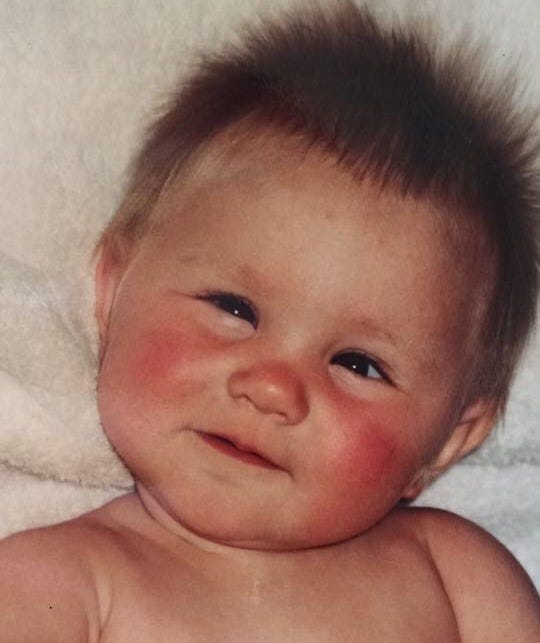
P.S. I’m a big fan of small children in glasses, especially the ones that clip round the back of the head. For example: Jacinda Ardern’s daughter, or this well-dressed diva.
STUFF YOU CAN EAT
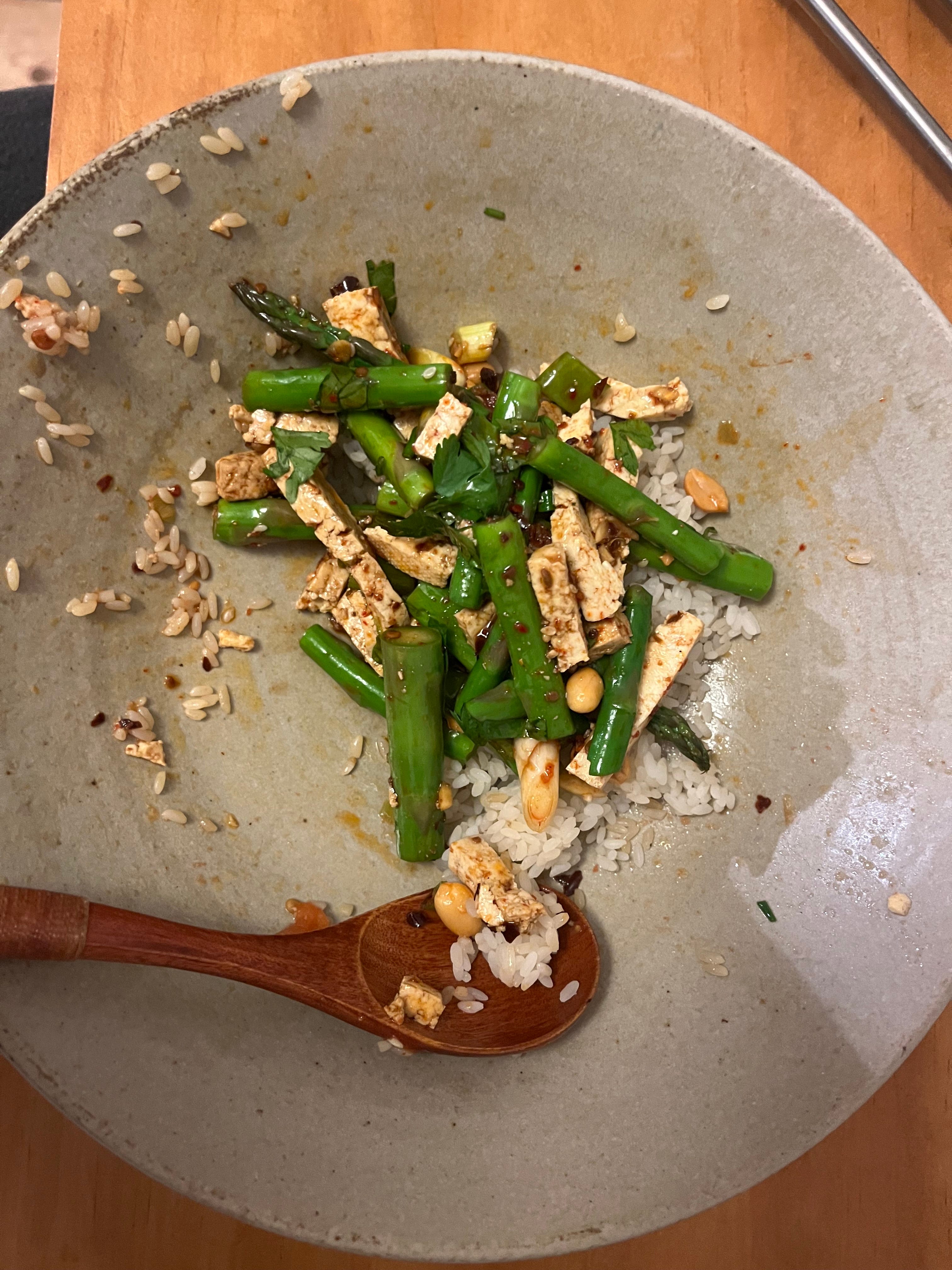
This highly inauthentic Sichuan-style asparagus and tofu salad is so good. I like it with tomato and egg stir fry and rice.
I recommend the rice noodles with roast duck in snail broth at Guilin Ramen House in central London.
Enjoyed this Guardian piece about the return of jelly. Gin and tonic jelly (individual ones?) seems quite festive.
I made a colour-coded map of small expat community Christmas markets in London (i.e. Finnish; Swedish; Danish), plus a few extras. It’s here. Relatedly, I’m hoping to pick up a Kouttone panettone at the Toklas Bakery Christmas Market on Dec. 6.
If I were in Melbourne, I’d probably get panettone at this bakery in Carlton North, as chronicled by The Editors of The Paris End.
This is a really good Sri Lankan restaurant in Wembley. Get the mutton lamprais. This is a really good Sri Lankan restaurant in Melbourne. And this is a really good Sri Lankan cookbook.
Samba rice is a South Asian rice with small, ovular grains that aren’t fluffy at all. It is absolutely delicious.
EVERYTHING ELSE

This is not ginger. (No, it’s not galangal either.) Instead, it’s a hyperrealistic teapot from the collection of the Asian Civilisations Museum in Singapore. If you look closely, you can see the edge of the lid at the top. Here’s another one in the form of a tree root.
It’s surprisingly inexpensive to buy a Roman coin.
Today is the birthday of the Italian architect and designer Gio Ponti, who died in 1979. I dream of his Villa Planchart — “a house as light as a butterfly resting on a hill” — in Caracas.
I saw The Line of Beauty at the Almeida and immediately took the novel out of the library. (So far, I like it less than Rebecca Makkai’s The Great Believers, while we’re talking about AIDs-era novels.) This three-star Guardian review seems fair. Wonderful costumes!
“What is this stirringly beautiful piece of music that YouTube has delivered to me?” I asked myself, opening the tab to check. It is: an arrangement of Alanis Morissette’s “You Oughta Know,” for strings. (My husband’s review: “It’s bad.”)
Poem about this time of year.
The others are Kane Williamson and Shane Warne. I also know of — and have actually interviewed — Ellyse Perry.